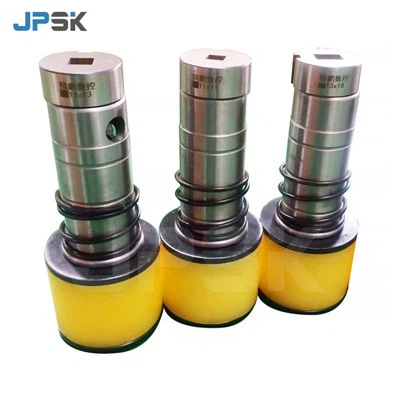
Hey there! As a supplier of punching corner molds, I often get asked about how to test the performance of these nifty little tools. Well, you've come to the right place. In this blog, I'll walk you through the steps and factors to consider when testing the performance of a punching corner mold.
1. Initial Visual Inspection
Before you even start any fancy testing, take a good look at the punching corner mold. Check for any visible signs of damage, such as cracks, chips, or misaligned parts. A mold with obvious flaws is likely to perform poorly and may even cause problems during the punching process. Make sure all the components are securely attached and that the cutting edges are sharp and clean. If you notice any issues, it might be a good idea to address them before proceeding with further testing.
2. Material Compatibility
One of the most important aspects of testing a punching corner mold is to ensure it's compatible with the material you'll be punching. Different materials have different hardness, ductility, and thickness, which can all affect the mold's performance. To test this, choose a sample of the material you plan to use and perform some trial punches.
First, set up your punching machine according to the mold's specifications. Make sure the pressure, speed, and alignment are all correct. Then, carefully place the sample material under the mold and initiate the punching process. Observe how the mold cuts through the material. Does it make a clean, smooth cut? Or does it tear, deform, or leave rough edges?
If the mold struggles to cut through the material, it could indicate a compatibility issue. Maybe the mold isn't designed for that specific type of material or the cutting edges aren't sharp enough. You can try adjusting the punching parameters, such as increasing the pressure or changing the speed, but if the problem persists, it might be time to look for a different mold.
3. Accuracy and Precision
Accuracy and precision are crucial when it comes to punching corner molds. An accurate mold will create corners that match the desired dimensions, while a precise mold will produce consistent results every time.


To test the accuracy, use a measuring tool, such as a caliper or a micrometer, to measure the dimensions of the punched corners. Compare these measurements to the design specifications. Is the length, width, and angle of the corner within the acceptable tolerance range? If not, the mold might need some adjustment or calibration.
For precision testing, punch multiple corners on the same material sample. Then, measure each corner and check for any variations in the dimensions. A high - precision mold will produce corners with minimal variation. If you notice significant differences between the punched corners, it could be a sign of a problem with the mold's alignment, wear and tear, or manufacturing defects.
4. Durability Testing
A good punching corner mold should be able to withstand repeated use without losing its performance. To test the durability, perform a high - volume punching test. Set up your punching machine and keep punching corners on the sample material for a set number of cycles. You can start with a few hundred cycles and gradually increase the number as you go.
During the test, keep an eye on the mold's performance. Are the cutting edges starting to dull? Is there any excessive wear on the mold components? Do the punched corners maintain their quality throughout the test? If you notice a significant degradation in the mold's performance after a relatively low number of cycles, it might not be durable enough for your needs.
5. Force and Energy Consumption
Measuring the force required to punch corners and the energy consumption can also give you valuable insights into the mold's performance. You can use a force sensor or a dynamometer to measure the punching force. A well - designed mold should require a reasonable amount of force to cut through the material. If the force is too high, it could lead to increased wear on the mold and the punching machine, as well as higher energy consumption.
To measure the energy consumption, you can use an energy meter attached to the punching machine. By comparing the energy consumption of different molds or different punching processes, you can identify the most energy - efficient option. This not only helps reduce operating costs but also has a positive impact on the environment.
6. Surface Finish
The surface finish of the punched corners is another important aspect of the mold's performance. A good mold should produce corners with a smooth, burr - free surface. To evaluate the surface finish, use a magnifying glass or a surface roughness tester. Look for any signs of burrs, scratches, or unevenness on the surface of the punched corners.
If the surface finish is poor, it could affect the quality of the final product, especially if the punched parts are used in applications where aesthetics or precision are important. You can try adjusting the punching parameters or sharpening the mold's cutting edges to improve the surface finish.
In the punching industry, we offer a range of high - quality molds. If you're interested in our Square Hole Punching Mold, Round Hole Punching Mold, or Punching Corner Mold, don't hesitate to reach out. We're here to assist you in finding the perfect mold for your needs. Whether you're a small - scale manufacturer or a large - scale industrial operation, our molds are designed to meet your requirements and help you achieve the best results.
7. Ejection Testing
Another factor to consider is the ejection of the punched parts from the mold. A well - performing mold should allow for easy and smooth ejection of the punched corners. To test this, after punching a corner, observe how the part is released from the mold. Does it come out easily, or does it get stuck?
If the part gets stuck, it could be due to a variety of reasons. Maybe there's not enough clearance between the mold and the punched part, or there's some debris or oil build - up inside the mold. You can try cleaning the mold, adjusting the ejection mechanism, or increasing the clearance to improve the ejection process.
Conclusion
Testing the performance of a punching corner mold involves a combination of visual, mechanical, and dimensional evaluations. By carefully examining factors such as material compatibility, accuracy, precision, durability, force and energy consumption, surface finish, and ejection, you can ensure that you're getting a high - quality mold that will meet your production needs.
If you're in the market for a punching corner mold or any other types of punching molds, we're here to help. Our team of experts has years of experience in the industry and can guide you through the selection process. We offer a wide range of molds, including Square Hole Punching Mold and Round Hole Punching Mold, so you're sure to find the right one for your application. Feel free to contact us for more information and to discuss your specific requirements.
References
- Smith, J. (2018). Handbook of Metal Forming. Publisher X.
- Johnson, A. (2020). Advanced Techniques in Punching and Stamping. Publisher Y.