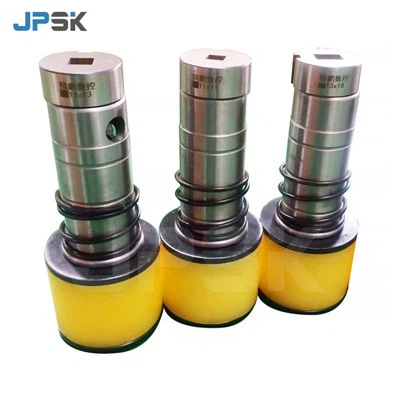
As a punching molds supplier, I've had hands - on experience with different kinds of punching molds like the Punching Corner Mold, Round Hole Punching Mold and Square Hole Punching Mold. In this blog, I'm gonna share the common surface treatments for punching molds.
1. Nitriding
Nitriding is one of the most popular surface treatments for punching molds. It involves introducing nitrogen into the surface layer of the mold. There are different types of nitriding, like gas nitriding and ion nitriding.
Gas nitriding is a relatively simple and cost - effective method. In this process, the mold is placed in a furnace filled with a nitrogen - containing gas. At high temperatures, the nitrogen atoms diffuse into the surface of the mold, forming a nitrided layer. This layer has excellent hardness, wear resistance, and corrosion resistance. The hardness can be significantly increased, which is great for punching molds as they constantly face friction and wear during the punching process.
Ion nitriding is a bit more advanced. It uses an electrical discharge to activate the nitrogen atoms and make them stick to the mold surface. The advantage of ion nitriding is that it can control the nitrided layer more precisely. You can adjust the thickness and properties of the layer according to your specific needs. For example, if you're making a mold for punching thin - walled materials, you might want a thinner but more uniform nitrided layer.
2. Chrome Plating
Chrome plating is another well - known surface treatment for punching molds. It's all about depositing a thin layer of chromium on the surface of the mold. Chrome has some great properties. It's very hard, more than four times as hard as steel in some cases. This hardness helps the mold resist wear.
The chrome plating process starts with cleaning the mold surface thoroughly. Any dirt or grease can affect the quality of the plating. Then, the mold is immersed in a solution containing chromium ions. An electric current is applied, which causes the chromium ions to deposit on the mold surface. The thickness of the chrome layer can be adjusted. For punching molds, a thickness of a few micrometers is usually enough to provide good wear resistance.


One of the benefits of chrome plating is its smooth surface. This smoothness reduces the friction between the mold and the workpiece during punching. It also makes it easier to eject the punched part from the mold, which can improve the production efficiency.
3. Boriding
Boriding is a surface treatment that forms a hard boride layer on the mold surface. In this process, the mold is heated in a boriding medium, which usually contains boron - containing compounds. The boron atoms diffuse into the surface of the mold, reacting with the base metal to form borides.
The boride layer has extremely high hardness and good wear resistance. It can resist abrasion even under high - pressure and high - speed punching conditions. For example, when punching hard materials like stainless steel or high - strength alloys, a borided punching mold can last much longer than an untreated one.
However, boriding also has some limitations. The boride layer is relatively brittle, so it might crack under certain conditions, like sudden impacts. You need to be careful when using borided molds, especially in applications where the punching force changes suddenly.
4. Titanium Nitride (TiN) Coating
TiN coating is a high - tech surface treatment for punching molds. It uses a physical vapor deposition (PVD) process to deposit a thin layer of titanium nitride on the mold surface. The PVD process works in a high - vacuum environment. Titanium and nitrogen are vaporized and then deposited on the mold surface in a controlled way.
TiN coating has a lot of advantages. First of all, it has a beautiful golden - yellow color, which is not just for looks but also an indication of its high - quality coating. It has excellent hardness, wear resistance, and oxidation resistance. The oxidation resistance is very important because in some punching processes, the mold can get hot, and oxidation can reduce the mold's performance.
The smooth surface of TiN coating also reduces friction. This leads to less heat generation during punching, which can protect both the mold and the workpiece. Plus, it can improve the surface finish of the punched parts.
5. Diamond - Like Carbon (DLC) Coating
DLC coating is a relatively new surface treatment for punching molds. It's a type of carbon - based coating that has properties similar to diamond. The coating is applied using a plasma - enhanced chemical vapor deposition (PECVD) process.
DLC coating has extremely low friction coefficients. This means that during punching, there's less resistance between the mold and the workpiece. It can reduce the punching force required, which can save energy and extend the life of the punching equipment.
The wear resistance of DLC coating is also very good. It can withstand a large number of punching cycles without significant wear. And it has good corrosion resistance, which is useful in environments where the mold might be exposed to moisture or chemicals.
Why Surface Treatments Matter
Surface treatments play a crucial role in the performance and lifespan of punching molds. Without proper surface treatment, a punching mold can wear out quickly. This leads to frequent mold replacements, which can be costly and time - consuming.
For example, if you're running a mass - production line, a worn - out mold can cause production delays. The quality of the punched parts might also be affected. With a well - treated mold, you can ensure consistent product quality and higher production efficiency.
Conclusion
As a punching molds supplier, I know how important it is to choose the right surface treatment for your punching molds. Whether it's nitriding, chrome plating, boriding, TiN coating, or DLC coating, each treatment has its own advantages and is suitable for different applications.
If you're in the market for high - quality punching molds or need advice on the best surface treatment for your specific needs, don't hesitate to get in touch. We're here to help you make the right choice and ensure your punching operations run smoothly.
References
- "Handbook of Metal Forming" by George E. Dieter
- "Surface Engineering for Wear Resistance" edited by S. K. Chatterjee
- Technical papers from the International Journal of Machine Tools and Manufacture