Hey there! As a supplier of copper rod bending molds, I often get asked about how to calculate the force required for these molds. It's a crucial aspect, especially for those in the manufacturing and metal - working industries. So, let's dive right in and break it down.
First off, we need to understand the basics of what's going on when we bend a copper rod. Bending a copper rod is essentially a process of deforming the material. When you use a Copper Rod Bending Mold, you're applying a force that causes the rod to change its shape. But how much force is enough?
Factors Affecting the Bending Force
There are several factors that come into play when calculating the force needed for a copper rod bending mold.
1. Material Properties of the Copper Rod
The type of copper used in the rod matters a great deal. Different copper alloys have different mechanical properties. For example, pure copper may be more malleable compared to a copper - alloy with a high percentage of other metals. The yield strength and ultimate tensile strength of the copper rod are key properties. Yield strength is the stress at which the copper starts to deform plastically, and the ultimate tensile strength is the maximum stress the rod can withstand before breaking. If you're working with a copper rod with a high yield strength, you'll need more force to bend it.
2. Rod Dimensions
The diameter and length of the copper rod are also important. A thicker rod will generally require more force to bend than a thinner one. The relationship between the diameter and the bending force is not linear. As the diameter increases, the force required to bend the rod increases exponentially. Similarly, the length of the rod can affect the bending process. A longer rod may be more flexible in some cases, but it also has more mass, which can increase the overall force needed for bending.
3. Bend Radius
The desired bend radius is a critical factor. A smaller bend radius means that the copper rod has to be deformed more sharply. This requires a greater force compared to a larger bend radius. For instance, if you want to create a tight 90 - degree bend with a small radius, you'll need to apply a significant amount of force to get the rod to conform to that shape.
4. Type of Bending Mold
The design of the copper rod bending mold can influence the force calculation. Different molds, such as Twist Bending Mold or more traditional straight - bending molds, have different ways of applying force to the rod. Some molds may distribute the force more evenly, while others may concentrate it in specific areas. This can affect the overall force required for the bending process.
Calculation Methods
Now, let's talk about how we can actually calculate the force. There are a few methods, and I'll go over the most common ones.
Simplified Empirical Formulas
One way is to use simplified empirical formulas. These formulas are based on years of experimentation and real - world data. For example, a simple formula for calculating the bending force (F) of a round copper rod in a simple bending operation is (F = k \times d^2 \times \sigma_y), where (k) is a constant that depends on the bend radius and the type of bending process, (d) is the diameter of the rod, and (\sigma_y) is the yield strength of the copper.


The value of (k) can be determined through experimentation or by referring to industry standards. For a standard 90 - degree bend with a relatively large radius, (k) might be around 0.5 - 1. However, for a sharp bend with a small radius, (k) could be 2 or more.
Finite Element Analysis (FEA)
For more accurate calculations, especially when dealing with complex bending scenarios or non - standard rod geometries, finite element analysis can be used. FEA is a computer - based method that divides the copper rod and the bending mold into small elements. It then analyzes the behavior of each element under the applied loads. This method takes into account the material properties, the geometry of the rod and the mold, and the boundary conditions. While FEA provides very accurate results, it requires specialized software and knowledge to set up and run the analysis.
Practical Example
Let's say you have a copper rod with a diameter of 10 mm, a yield strength of 200 MPa, and you want to create a 90 - degree bend with a bend radius of 20 mm. Using the simplified empirical formula with (k = 1), we can calculate the bending force.
First, we square the diameter: (d^2=(10\space mm)^2 = 100\space mm^2). Then we multiply by the yield strength (\sigma_y = 200\space MPa=200\space N/mm^2).
The bending force (F=k\times d^2\times\sigma_y = 1\times100\space mm^2\times200\space N/mm^2 = 20000\space N) or 20 kN.
Keep in mind that this is a simplified calculation, and in a real - world scenario, other factors may come into play.
Importance of Accurate Force Calculation
Accurately calculating the force required for a copper rod bending mold is crucial for several reasons. If you apply too little force, the copper rod won't bend to the desired shape, and you may end up with an incomplete or inaccurate bend. On the other hand, if you apply too much force, you risk damaging the rod, such as cracking or breaking it. Additionally, over - applying force can also put excessive stress on the bending mold, which can lead to premature wear and tear of the mold.
Our Mold Solutions
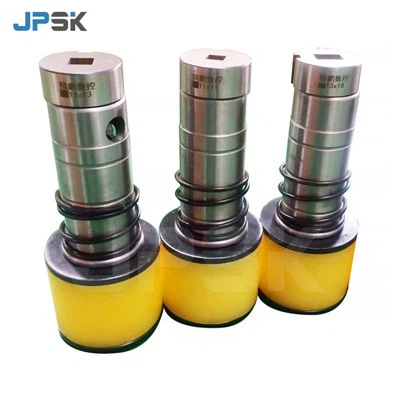
At our company, we offer a wide range of high - quality Copper Rod Bending Molds. Our molds are designed to work efficiently with different copper rod dimensions and bend requirements. We also have Twist Bending Molds for more complex bending operations, as well as Cable Connector Processing Molds for specific applications.
If you're in the process of calculating the force for your copper rod bending needs and need advice on the right mold, we're here to help. Our team of experts has years of experience in the field and can assist you in choosing the most suitable mold for your project. Whether you're a small - scale workshop or a large - scale manufacturing plant, we have the solutions for you.
If you're interested in our copper rod bending molds or have any questions about the force calculation process, don't hesitate to reach out. We're eager to start a conversation and help you with your bending requirements.
References
- "Metal Forming Handbook: Processes and Applications" by G. E. Dieter
- "Manufacturing Engineering and Technology" by S. Kalpakjian and S. R. Schmid